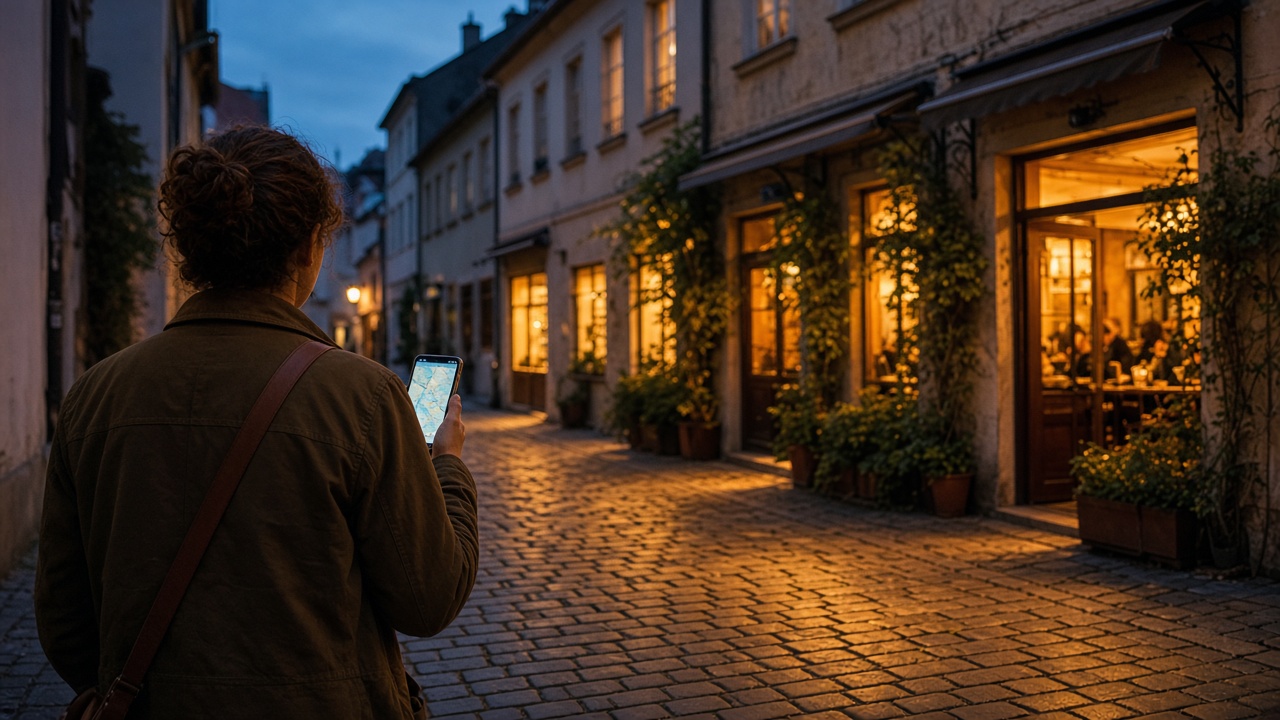
You land in a city you've never visited. It's 6:30 p.m. You're hungry. You open a maps app, see four thousand pins, and suddenly dinner feels like a research project. Forty minutes later you're still reading reviews, everyone's hangry, and you end up at the place closest to the hotel because decision fatigue won.
That cycle is normal. It's also mostly avoidable. Picking a restaurant in an unfamiliar city isn't about finding the single best meal on earth — it's about filtering noise fast, reading signals that actually correlate with a good experience, and knowing when to stop researching and start walking.
This is the workflow I use when traveling — business trips, weekend hops, layovers with a three-hour window. No influencer lists required.
Define "Good" Before You Search
"Best restaurant in Barcelona" is a useless query if you don't know what you want tonight. Good for whom, for what occasion, at what budget?
Narrow the frame in thirty seconds:
- Distance radius. Will you walk 15 minutes, or is anything beyond two blocks dead?
- Energy level. Sit-down meal, counter spot, or grab-and-go because you're tired?
- Cuisine openness. Local only, or fine with a solid Italian place if the local scene is closed on Monday?
- Price band. Set a ceiling now. Scrolling $$$$ places when you're in a $$ mood wastes time.
- Time constraint. Need to eat in 45 minutes before a show, or is this the main event?
Once those five answers exist, half the map pins disappear without you reading a single review.
Red Flags You Can Spot from the Street
Some bad picks announce themselves before you open an app. Tourist-trap restaurants share a visual language that's remarkably consistent across countries:
- Multilingual photo menus on easels outside — often with flags and stock photos of pasta.
- A host actively pulling people in — good rooms rarely need barkers.
- Prime square or monument frontage + empty tables at peak dinner hour — locals already voted.
- Same dishes photographed on every neighboring storefront — generic supply-chain cooking.
- "We have English menu" as the main selling point — fine for accessibility, suspicious as the only hook.
None of these is a guaranteed bad meal. They're correlation, not proof. But when you're time-boxed, skipping obvious traps is free efficiency.
How to Read Reviews Without Getting Fooled
Star averages lie politely. A 4.6 can mean "life-changing tasting menu" or "fine for airport food" depending on who's rating and why. Read reviews like a skeptic, not a optimist.
Ignore the top three and bottom three
Sort by "most recent" and skim the middle. Five-star reviews that read like marketing copy ("Best experience ever!!! Must try!!!") and one-star rants about wait times on Valentine's Day both distort the picture. You're looking for recurring themes in the 3–4 star range — the honest band.
Look for dish-level detail
"Food was good" tells you nothing. "Grilled mackerel was dry but the lentil soup was excellent" tells you what to order or skip. Specific praise for two or three dishes across multiple reviews is one of the strongest signals available on public platforms.
Check review dates and context
A restaurant that was great in 2019 may have changed chefs, owners, or suppliers. Recent reviews matter more. Also note whether complaints are about food quality (structural problem) or service on one busy Saturday (noise).
Be wary of review velocity spikes
Hundreds of five-star reviews posted in a two-week window, all with similar phrasing, is a pattern worth noticing. Organic praise tends to arrive unevenly over months and years.
Rule of thumb: if you can't name one dish you'd order based on reviews alone, you don't have enough signal yet — or the restaurant is generic enough that nothing stands out.
Go Neighborhood-First, Not Restaurant-First
The most reliable travel-food hack is embarrassingly simple: pick a neighborhood where people live and eat, then choose among what's there.
Tourist cores optimize for foot traffic, not repeat customers. Residential or mixed-use districts — a few blocks off the main drag, near a market, along a tram line locals use — concentrate restaurants that survive on regulars. You don't need to know the city; you need to zoom the map until chain logos thin out and independent names cluster.
- Near universities — often good cheap eats, late hours, high turnover keeps quality honest.
- Near covered markets — lunch counters and suppliers' spin-off restaurants; ingredients move fast.
- One stop past the obvious transit hub — the difference between "next to the station" and "two stops out" is often the difference between trap and treasure.
Use Maps the Right Way
Maps apps are discovery tools, not oracles. Here's how to extract signal from them quickly:
- Drop a pin where you'll actually be — hotel, meeting, museum exit — not city center by default.
- Filter by open now — saves the heartbreak of falling in love with a place that's closed Tuesdays.
- Scan the map visually — clusters of pins in one block beat a lone highly-rated island surrounded by nothing.
- Cross-reference one curated list — a local guide, a reputable food publication, or a trusted awards program. One list, not twelve.
- Build a shortlist of three — not twenty. Three is enough for backup if the first is full.
If you care about structured restaurant discovery — starred lists, check-ins, seeing what's worth the detour on a map — tools built for that beat generic search. We ship NomNom Map for exactly this: 3,300+ curated restaurants worldwide on an interactive map, so you can see what's near you without wading through every cafe that bought ads. It's optional. A good neighborhood walk and ten minutes of review reading still gets you most of the way there.
Timing, Reservations, and Walk-In Reality
The best restaurant in town is useless if you can't get a table. Check this before you fall in love:
- Peak hours vary by city. Madrid dinner at 10 p.m. is normal; in Tokyo, many serious places are reservation-only and book weeks out.
- Lunch can be the move. Same kitchen, lower stakes, often a set menu that's better value than dinner.
- Bar seats and counters — walk-in friendly in many cities when the dining room is full.
- Call or book online early if your shortlist includes anywhere with limited seats. Don't assume Friday-at-8 walk-in luck.
If reservations aren't happening and you're hungry now, downgrade gracefully: a busy izakaya, a market stall, a bakery that sells hot savory items — fast, local, low regret.
The Ten-Minute Pre-Dinner Workflow
When you need a decision now, run this sequence. Set a timer if you have to.
- Minutes 0–2: Write down radius, budget, time, and sit-down vs quick. Non-negotiable.
- Minutes 2–4: Pick one neighborhood block on the map. Pan until independent names cluster.
- Minutes 4–6: Save three candidates that pass the red-flag check at a glance.
- Minutes 6–8: Skim recent reviews for dish names and repeat complaints. Pick a front-runner.
- Minutes 8–9: Check reservation or walk-in. Call if needed.
- Minute 10: Go. If #1 is full, try #2 without reopening research.
The timer matters. Research has diminishing returns after ten minutes unless you're planning a special-occasion meal days in advance. For tonight's dinner, speed beats perfection.
When to Trust a List vs. When to Wander
Curated lists — guidebooks, awards, editorial roundups — are high-signal but incomplete. They skew toward sit-down dining, reservation culture, and places that fit a critic's narrative. Street food, family canteens, and neighborhood joints often never appear.
Use lists to anchor a trip: one or two meals worth planning around. Use wandering for everything else. The hybrid works — starred lunch on Saturday, random Tuesday night counter spot — better than trying to list-optimize every single meal.
What to Do When You're Wrong
You will pick a mediocre meal sometimes. That's data, not failure. Note what misled you — too many five-star bots, wrong neighborhood, ordered the signature dish everyone photographs instead of the daily special — and adjust the next night. Two bad picks in a row usually means your filters are off, not that the city has no good food.
Also: a "bad" meal in a foreign city is often just unfamiliarity. You didn't know you were supposed to squeeze lemon on the schnitzel, or that the house wine is ordered by the liter. Ask the server one question — "what do locals order?" — before you write the place off.
The Minimum Viable Dinner
If all else fails, optimize for low regret rather than maximum glory:
- A busy place with a short menu, within walking distance, where you can see the kitchen or grill.
- Order the daily special or the item the server recommends without overthinking.
- Split two dishes if traveling with someone — more signal per sitting.
- Save the ambitious reservation for a night when you're not exhausted from transit.
The goal in an unknown city isn't to never eat a forgettable meal. It's to spend less time anxious about choosing and more time actually at the table — present, fed, and ready for whatever tomorrow's neighborhood looks like.